Our Research
Research in the Greene Lab
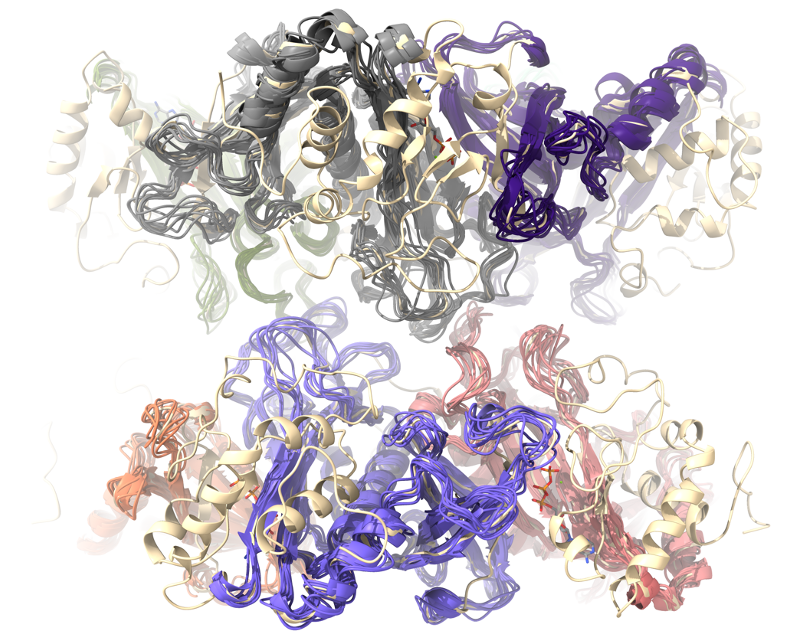
The Greene Lab’s research focuses on biochemistry, molecular biology, and structural biology, with an emphasis on understanding protein and enzyme function and regulation in human health and disease. This research platform serves as a training pipeline for students to learn cryo-electron microscopy (cryo-EM) data analysis and sample preparation. We apply this technique to the study of enzyme conformational heterogeneity and other macromolecular compelexes. Enzymes must undergo conformational changes to enhance enzymatic catalysis, and most enzymes form complexes that are available for structural determination by cryo-EM. Additionally, we study protein amyloids which are commonly found in disease states and have distinct shapes that cryo-EM is best at elucidated. Overall, the Greene lab aims to elucidate the fundamental principles of protein activity and regulation, as this basic knowledge contributes to potential therapeutic advancements.
Investigating the Ensemble-Function Relationship of Metabolic Enzymes

Ensemble-function analysis of metabolic enzymes such as glutamine synthetase (GS) and argininosuccinate synthetase I (ASS1). We work in large teams to solve cryogenic electron microscopy structures, perform MD ensemble refinement, and rationalize functional hypotheses for what conformations confer what features to the enzyme. We then experimentally test our hypotheses biochemically and with further structural models.
Screening Cytosolic Metabolites for Activity Modulations
Protein-metabolite interactions are critical for the rapid, protein-level regulation of metabolic enzymes in response to cellular changes. While extensively studied in central carbon metabolism, their prevalence in nitrogen metabolism is less understood. A prime example is glutamine synthetase (GS), a key enzyme in nitrogen metabolism vital for cell growth and detoxification. GS dysregulation is implicated in significant diseases, from cancer to neurodegenerative disorders like hepatic encephalopathy and Alzheimer’s. Despite its importance, protein-level regulation of GS is poorly characterized, largely due to a dearth of identified allosteric regulators capable of selectively modulating its activity. To identify novel regulators, we screened a library of over 800 endogenous metabolites for their impact on GS Michaelis-Menten constants using an NADH-coupled continuous assay, with a counter-screen to ensure specificity. This effort led to the discovery of neopterin as an inhibitor of GS activity. We are currently investigating the precise nature of this interaction through steady-state kinetics and cryo-electron microscopy (cryoEM). Elucidating the neopterin binding site on GS will determine if its inhibition is allosteric, a finding that could significantly broaden the therapeutic strategies for targeting GS beyond existing orthosteric inhibitors.